Showing posts with label technology. Show all posts


Apple won't release its next-generation iPhone until the fall of 2016, so there are still months of development ahead. For the current time, Apple's flagship iPhones are the iPhone 6s and the iPhone 6s Plus, released to the public in September of 2015.

Though it will be several months before the new iPhone 7 launches, rumors about the device started trickling out in January of 2016. We've already gleaned many details about the upcoming iPhone, giving us plenty of information on what to expect when it debuts.

Since the 3GS launched in 2009, Apple has used an alternating "S" naming formula to mark years where the iPhone does not receive a major redesign, saving its numbered upgrades for years where design changes are introduced.

Releases have been as follows:


2007 - iPhone


2008 - iPhone 3G
2009 - iPhone 3GS
2010 - iPhone 4 (new design)
2011 - iPhone 4s
2012 - iPhone 5 (new design)
2013 - iPhone 5s
2014 - iPhone 6 and iPhone 6 Plus (new design)
2015 - iPhone 6s and iPhone 6s Plus


The next-generation iPhone is expected to be called the iPhone 7, but there have been some rumors suggesting Apple could drop its standard numbered naming convention, instead calling the 2016 iPhone the "iPhone Pro." It is unclear at this point if those rumors are accurate.

Because 2015 marked an "S" iPhone upgrade year that introduced new features such as an improved camera and a better processor, 2016 will bring an even-year upgrade that will include a new iPhone design in addition to new features.


Specification 


Apple will continue releasing two versions of each iPhone, so we can expect to see an iPhone 7 and an iPhone 7 Plus in 2016. Apple is said to be planning to stick to the 4.7- and 5.5-inch screen sizes it first introduced with the iPhone 6 and 6 Plus.

Apple could make some big changes on the iPhone 7’s spec sheet. The latest rumor from 9to5Mac hints that the next iPhone may finally come with a minimum of 32GB of storage. The news comes from one IHS Technology analyst, whose sources and research seem to confirm that Apple will finally increase the amount of storage on the base iPhone model.

As for other specs, there are a number of reports hinting that Apple will move from LCD screens to OLED screens in the near future. Some reports say the iPhone 7 will get an OLED screen, but others say the new screens won’t be ready in time and will arrive on later iPhones.

Analyst Kuo also chimed in on the iPhone 7 with another report, claiming it will run on a new A10 chip built entirely by TSMC, a Taiwanese chip manufacturer that has worked with Apple in the past, and built some of the current A9 processors. He also claims the iPhone 7 Plus will have 3GB of RAM, while the iPhone 7 will only use 2GB. Foxconn will apparently manufacture the iPhone 7 and 7 Plus, and it should launch towards the end of this year, says Kuo.

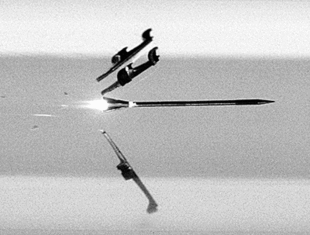
Armour-Piercing Discarding Sabot (APDS) was initially the main design of the kinetic energy (KE) penetrator. The logical progression was to make the shot longer and thinner to concentrate the kinetic energy in a smaller area. However a long thin rod is aerodynamically unstable; it tends to tumble in flight and is less accurate.


Traditionally, shells were given stability in flight from the rifling of the gun barrel, which imparts a spin to the round. Up to a certain limit this is effective, but once the projectile's length is more than six or seven times its diameter, rifling becomes less effective.


Adding fins like the fletching of an arrow to the base gives the round stability. The spin from rifling decreases the effective penetration of these rounds (rifling diverts some of the linear kinetic energy to rotational kinetic energy, thus decreasing the round's velocity and impact energy) and so they are generally fired from smoothbore guns, a practice that has been taken up by China, Israel, France, South Korea, Germany, Russia, and the United States in their tanks. Another reason for the use of smoothbore guns is that shaped charge HEAT munitions lose much of their effect to rotation. APFSDS can still be fired from rifled guns but the sabot is of a modified design incorporating bearings to isolate the spin of the sabot in the barrel from the round itself, so far as practicable.
Rifled guns have been kept in use by some nations (the UK and India, for example) because they are able to fire other ammunition such as HESH rounds with greater accuracy. However, the rifling wears down under regular APFSDS use and requires more maintenance. For these reasons a

British Challenger 2 tank was modified under the Challenger Lethality Improvement Programme to mount a Rheinmetall 120mm

smoothbore gun. However this programme has now been discontinued because of the impossibility of stowing an adequate quantity of the new fixed (one-piece) ammunition without replacing the powerpack to create additional hull volume.


Indian Navy is set to test fire the long-range surface-to-air Barak 8 missile, jointly developed by India and Israel. The missile system aims to enhance the Navy’s capabilities against incoming missiles, planes and drones.

If the test is successful, it will pave the way for final installation of Barak 8 missile on board Indian warships.

We take a look at the salient features of the missile system


The missile had undergone a successful test in Israel last November. Barak 8 is an upgraded version of the Barak system both countries already use.

Barak 8 is considered to be a major asset for Indian Navy because it adds a potent system designed to destroy any anti-ship missile launched by Pakistani or Chinese navy. According to Israel Aerospace Industries, Barak 8 provides protection against a variety of aerial platforms and munitions including aircraft, helicopters, unmanned aircraft and sea-skimming missiles.

It is based on a sophisticated missile (developed in collaboration with Rafael), state-of-the-art phased array multi mission radar, two-way data link, and flexible command and control system.

The system has a multi-mission radar, supporting air defense missions. Israel Aerospace Industries further says that the Barak 8 can operate day and night, in all weather conditions, and successfully deals with simultaneous threats engagements, even in severe saturation scenarios.

‘The system has a very short reaction time and a fast missile vertical launch capability with 360 degree coverage,’ claims Israel Aerospace Industries.

‘The missile deals with short, medium, and long range threats, where its interconnectivity among the various ships in the naval task force enables it to be a multi-layer air and missile defense System of Systems,’ it adds.Key to Barak 8’s ability to intercept incoming missiles is Israel-made MF-STAR radar system which is capable of simultaneously tracking hundreds of airborne targets to a range of more than 250 kilometers.

The missile is being jointly developed by Israel Aerospace Industries, India’s DRDO, Israel’s Administration for the Development of Weapons and Technological Infrastructure, Elta Systems, Rafael and other companies.


The state-run Bharat Dynamics Limited (BDL) will series-produce the 70 km-range Barak-8, with 32 missiles to be initially fitted onto INS Kolkata. 'The test will be held during the coming monsoon so that actual operating challenge is created,' defence sources have said adding that it would be held on INS Kolkata.

The launchers and radars to track the missile are already in place.

The test will be conducted against an incoming missile by the Navy. In this video provided by Israel Aerospace Industries, watch the test launch of Barak 8 missile system.


The prestigious GAGAN project, which will make India only the fourth country in the world to have this system, will finally be inaugurated on Monday. The project is expected to give a major boost to the Indian aviation navigation system and also help neighboring countries.

As per the plans drawn by the ministry of civil aviation, the program will be inaugurated by aviation minister Gajapathi Raju in New Delhi. ” GAGAN will be dedicated to the nation” said a senior AAI official.

GAGAN, which stands for GPS Aided GEO Augmented Navigation, is a joint collaboration between the Airports Authority of India (AAI) and Indian Space Research Organization. Although a lot of technology and instruments used for GAGAN have been procured from abroad, a lot of indigenous improvisation has been made in it.

According to AAI officials, GAGAN is designed to provide additional accuracy, availability and integrity necessary to enable users to rely on GPS for all phases of flight.

Officials involved with the development of the project stated that increased accuracy would help in position reporting, allowing for more uniform and high-quality air traffic management.

In addition, GAGAN will provide benefits beyond aviation to all modes of transport, including maritime, highways, and railroads. GAGAN offers free enhanced satellite navigation signals over India, which are 10 times more precise than GPS.


Dhanush artillery guns -indigenous Bofors guns--have gone for confirmatory trials that will last till early next year, as the army looks for new howitzers. Defence sources said if the confirmatory tests of the indigenously-developed guns comes out as positive, it will pave the way for Bulk Production Clearance (BPC).

Under the first phase, the army will place an order worth over Rs 1,200 crore for 114 such guns with the Ordnance Factories Board.

"The confirmatory trials are going on after and if they prove to be successful, the guns will go in for bulk production for the Army," sources told PTI.

The Gun Carriage Factory, Jabalpur, plans to supply 6 guns within 6 months, another 12 within the next one year before ramping up the production.


Dhanush will be the first artillery gun to be acquired by the army since the purchase of Bofors guns from Sweden in 1987. It is a modified version of the Bofors and underwent winter trial in 2013 and summer trials in 2014.

Defence minister Manohar Parrikar had earlier this year said the tests for the 155/45mm caliber Dhanush gun was successful. Sources said minor changes were done following the trials, following which the confirmation trials have begun.

OFB is a conglomerate of 39 ordnance factories with another two new projects being set up at Nalanda in Bihar and Korwa in Uttar Pradesh.

After Bofors, defence ministry to purchase guns again: Parrikar ::

''With no guns being purchased by the government ever since controversial Bofors guns were purchased, the defence ministry has now decided to purchase guns from foreign countries. The ministry would initiate the process for the same'', defence minister Manohar Parrikar said.


Parrikar, who was in Lucknow to attend the training programme of elected cantonment board members, said that defence ministry would also begin the process of replacing MIG 21 fighter jets with indigenously built Tejas. However, he said that it would be a gradual process and replacing a large fleet would cost more. The process of replacing MIGs with Tejas would be done over a period of 20 years or so, he added.

Talking to a few journalists at the party headquarters in Lucknow later, Parrikar said that more howitzer guns would be deployed in the northeast region and added that parts for these guns would be bought from the USA.

To a question on ending terrorism, Parrikar said that it could only eradicated by means of economic development of the region. Mostly young youths who are lured by monetary offers get trapped and land up indulging in terror activities. However, if the focus is on economic development of the region, everyone would get job and the youth would not deviate towards subversive activities.


Riding on Make in India wave Tata Motors wants to build 'Battle Tanks'.


The defence division of Tata Motors, India's biggest automaker, is eyeing Rs 60,000 crore contracts to build combat vehicles, double turnover in two years and supply main battle tanks to the Indian Army as it aims to defend its leadership position among the private companies.

The pace of aggression by local companies like Tata Motors is centered over the race to have the largest piece of the $100 billion worth of defence acquisition laid out by Prime Minister Narendra Modi over the next decade from local companies.

The Mumbai-based company bagged a Rs 914 crore contract to supply 1,239 indigenously developed high mobility multi-axle vehicles, which is the single largest order awarded to an Indian private original equipment manufacturers in land systems under the DPP by the Indian Army.

Vernon Noronha, vice president, defence and government business, Tata Motors said, "In the last two years of the previous government there was almost no orders coming but one year after the present government came into power and all our stuck filed started moving and there was a very quick acceleration of orders. And this has enthused not just for Tata Motors but for the entire auto industry."

Tata Motors has an order book of Rs 1,500 crore to be executed over the next two years. It clocked revenues of Rs 1,200 crore last year and aims to double it in two years, Noronha added. In the last three years the division generated revenues of Rs 2,000 crore or about 3 per cent of Tata Motors total revenues.

Indian companies are fast building capabilities to grab a piece of the defence pie. For instance in less than two weeks Mahindra & Mahindra forged alliances with two European companies to supply underwater warfare equipments and military choppers to the armed forces. Anil Ambani-led Reliance Group entered the defence sector with the acquisition of Pipavav Defence.

"Earlier Indian vehicles were called for trials or when RFPs (request for proposal) were issued at snails pace, today the Indian Army and ministry of defence is chasing companies asking us to put our vehicles for trails as fast as possible", Noronha added.

The Rs 60,000 crore contract to build Future Infantry Combat Vehicle (FICV) is one of the biggest defence contracts of recent times. The previous UPA government had floated an expression of interest (EoI) in 2008 following which eight private Indian companies responded including Bharat Forge, Titagarh Wagons, M&M and Tata Motors. The Modi government scraped the previous EoI and a revised EoI is expected to be issued in the next couple of months.

Besides orders worth Rs 1,053 crore for the light armoured multipurpose vehicle (LAMV), more than Rs 1,000 crore for armoured personnel carrier (Kestrel) and Rs 3,000 crore for general service vehicles are also targeted by the same companies. The wheeled infantry combat vehicle is being built by Tata Motors in association with the Defence Research and Development Organisation (DRDO) for which the Army is looking to procure 100 units.

"Eventually we would like to become a manufacturer of light tank and then the main battle tank in the future. That is how we would like the progression to happen. The army released a request for information to develop future ready combat vehicle (FRCV) which will be the main battle tank. We have also put in a response", added Noronha

Courtesy: IBC News