Showing posts with label technology. Show all posts


Apple won't release its next-generation iPhone until the fall of 2016, so there are still months of development ahead. For the current time, Apple's flagship iPhones are the iPhone 6s and the iPhone 6s Plus, released to the public in September of 2015.

Though it will be several months before the new iPhone 7 launches, rumors about the device started trickling out in January of 2016. We've already gleaned many details about the upcoming iPhone, giving us plenty of information on what to expect when it debuts.

Since the 3GS launched in 2009, Apple has used an alternating "S" naming formula to mark years where the iPhone does not receive a major redesign, saving its numbered upgrades for years where design changes are introduced.

Releases have been as follows:


2007 - iPhone


2008 - iPhone 3G
2009 - iPhone 3GS
2010 - iPhone 4 (new design)
2011 - iPhone 4s
2012 - iPhone 5 (new design)
2013 - iPhone 5s
2014 - iPhone 6 and iPhone 6 Plus (new design)
2015 - iPhone 6s and iPhone 6s Plus


The next-generation iPhone is expected to be called the iPhone 7, but there have been some rumors suggesting Apple could drop its standard numbered naming convention, instead calling the 2016 iPhone the "iPhone Pro." It is unclear at this point if those rumors are accurate.

Because 2015 marked an "S" iPhone upgrade year that introduced new features such as an improved camera and a better processor, 2016 will bring an even-year upgrade that will include a new iPhone design in addition to new features.


Specification 


Apple will continue releasing two versions of each iPhone, so we can expect to see an iPhone 7 and an iPhone 7 Plus in 2016. Apple is said to be planning to stick to the 4.7- and 5.5-inch screen sizes it first introduced with the iPhone 6 and 6 Plus.

Apple could make some big changes on the iPhone 7’s spec sheet. The latest rumor from 9to5Mac hints that the next iPhone may finally come with a minimum of 32GB of storage. The news comes from one IHS Technology analyst, whose sources and research seem to confirm that Apple will finally increase the amount of storage on the base iPhone model.

As for other specs, there are a number of reports hinting that Apple will move from LCD screens to OLED screens in the near future. Some reports say the iPhone 7 will get an OLED screen, but others say the new screens won’t be ready in time and will arrive on later iPhones.

Analyst Kuo also chimed in on the iPhone 7 with another report, claiming it will run on a new A10 chip built entirely by TSMC, a Taiwanese chip manufacturer that has worked with Apple in the past, and built some of the current A9 processors. He also claims the iPhone 7 Plus will have 3GB of RAM, while the iPhone 7 will only use 2GB. Foxconn will apparently manufacture the iPhone 7 and 7 Plus, and it should launch towards the end of this year, says Kuo.

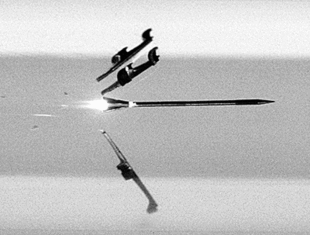
Armour-Piercing Discarding Sabot (APDS) was initially the main design of the kinetic energy (KE) penetrator. The logical progression was to make the shot longer and thinner to concentrate the kinetic energy in a smaller area. However a long thin rod is aerodynamically unstable; it tends to tumble in flight and is less accurate.


Traditionally, shells were given stability in flight from the rifling of the gun barrel, which imparts a spin to the round. Up to a certain limit this is effective, but once the projectile's length is more than six or seven times its diameter, rifling becomes less effective.


Adding fins like the fletching of an arrow to the base gives the round stability. The spin from rifling decreases the effective penetration of these rounds (rifling diverts some of the linear kinetic energy to rotational kinetic energy, thus decreasing the round's velocity and impact energy) and so they are generally fired from smoothbore guns, a practice that has been taken up by China, Israel, France, South Korea, Germany, Russia, and the United States in their tanks. Another reason for the use of smoothbore guns is that shaped charge HEAT munitions lose much of their effect to rotation. APFSDS can still be fired from rifled guns but the sabot is of a modified design incorporating bearings to isolate the spin of the sabot in the barrel from the round itself, so far as practicable.
Rifled guns have been kept in use by some nations (the UK and India, for example) because they are able to fire other ammunition such as HESH rounds with greater accuracy. However, the rifling wears down under regular APFSDS use and requires more maintenance. For these reasons a

British Challenger 2 tank was modified under the Challenger Lethality Improvement Programme to mount a Rheinmetall 120mm

smoothbore gun. However this programme has now been discontinued because of the impossibility of stowing an adequate quantity of the new fixed (one-piece) ammunition without replacing the powerpack to create additional hull volume.


Indian Navy is set to test fire the long-range surface-to-air Barak 8 missile, jointly developed by India and Israel. The missile system aims to enhance the Navy’s capabilities against incoming missiles, planes and drones.

If the test is successful, it will pave the way for final installation of Barak 8 missile on board Indian warships.

We take a look at the salient features of the missile system


The missile had undergone a successful test in Israel last November. Barak 8 is an upgraded version of the Barak system both countries already use.

Barak 8 is considered to be a major asset for Indian Navy because it adds a potent system designed to destroy any anti-ship missile launched by Pakistani or Chinese navy. According to Israel Aerospace Industries, Barak 8 provides protection against a variety of aerial platforms and munitions including aircraft, helicopters, unmanned aircraft and sea-skimming missiles.

It is based on a sophisticated missile (developed in collaboration with Rafael), state-of-the-art phased array multi mission radar, two-way data link, and flexible command and control system.

The system has a multi-mission radar, supporting air defense missions. Israel Aerospace Industries further says that the Barak 8 can operate day and night, in all weather conditions, and successfully deals with simultaneous threats engagements, even in severe saturation scenarios.

‘The system has a very short reaction time and a fast missile vertical launch capability with 360 degree coverage,’ claims Israel Aerospace Industries.

‘The missile deals with short, medium, and long range threats, where its interconnectivity among the various ships in the naval task force enables it to be a multi-layer air and missile defense System of Systems,’ it adds.Key to Barak 8’s ability to intercept incoming missiles is Israel-made MF-STAR radar system which is capable of simultaneously tracking hundreds of airborne targets to a range of more than 250 kilometers.

The missile is being jointly developed by Israel Aerospace Industries, India’s DRDO, Israel’s Administration for the Development of Weapons and Technological Infrastructure, Elta Systems, Rafael and other companies.


The state-run Bharat Dynamics Limited (BDL) will series-produce the 70 km-range Barak-8, with 32 missiles to be initially fitted onto INS Kolkata. 'The test will be held during the coming monsoon so that actual operating challenge is created,' defence sources have said adding that it would be held on INS Kolkata.

The launchers and radars to track the missile are already in place.

The test will be conducted against an incoming missile by the Navy. In this video provided by Israel Aerospace Industries, watch the test launch of Barak 8 missile system.


The prestigious GAGAN project, which will make India only the fourth country in the world to have this system, will finally be inaugurated on Monday. The project is expected to give a major boost to the Indian aviation navigation system and also help neighboring countries.

As per the plans drawn by the ministry of civil aviation, the program will be inaugurated by aviation minister Gajapathi Raju in New Delhi. ” GAGAN will be dedicated to the nation” said a senior AAI official.

GAGAN, which stands for GPS Aided GEO Augmented Navigation, is a joint collaboration between the Airports Authority of India (AAI) and Indian Space Research Organization. Although a lot of technology and instruments used for GAGAN have been procured from abroad, a lot of indigenous improvisation has been made in it.

According to AAI officials, GAGAN is designed to provide additional accuracy, availability and integrity necessary to enable users to rely on GPS for all phases of flight.

Officials involved with the development of the project stated that increased accuracy would help in position reporting, allowing for more uniform and high-quality air traffic management.

In addition, GAGAN will provide benefits beyond aviation to all modes of transport, including maritime, highways, and railroads. GAGAN offers free enhanced satellite navigation signals over India, which are 10 times more precise than GPS.


Dhanush artillery guns -indigenous Bofors guns--have gone for confirmatory trials that will last till early next year, as the army looks for new howitzers. Defence sources said if the confirmatory tests of the indigenously-developed guns comes out as positive, it will pave the way for Bulk Production Clearance (BPC).

Under the first phase, the army will place an order worth over Rs 1,200 crore for 114 such guns with the Ordnance Factories Board.

"The confirmatory trials are going on after and if they prove to be successful, the guns will go in for bulk production for the Army," sources told PTI.

The Gun Carriage Factory, Jabalpur, plans to supply 6 guns within 6 months, another 12 within the next one year before ramping up the production.


Dhanush will be the first artillery gun to be acquired by the army since the purchase of Bofors guns from Sweden in 1987. It is a modified version of the Bofors and underwent winter trial in 2013 and summer trials in 2014.

Defence minister Manohar Parrikar had earlier this year said the tests for the 155/45mm caliber Dhanush gun was successful. Sources said minor changes were done following the trials, following which the confirmation trials have begun.

OFB is a conglomerate of 39 ordnance factories with another two new projects being set up at Nalanda in Bihar and Korwa in Uttar Pradesh.

After Bofors, defence ministry to purchase guns again: Parrikar ::

''With no guns being purchased by the government ever since controversial Bofors guns were purchased, the defence ministry has now decided to purchase guns from foreign countries. The ministry would initiate the process for the same'', defence minister Manohar Parrikar said.


Parrikar, who was in Lucknow to attend the training programme of elected cantonment board members, said that defence ministry would also begin the process of replacing MIG 21 fighter jets with indigenously built Tejas. However, he said that it would be a gradual process and replacing a large fleet would cost more. The process of replacing MIGs with Tejas would be done over a period of 20 years or so, he added.

Talking to a few journalists at the party headquarters in Lucknow later, Parrikar said that more howitzer guns would be deployed in the northeast region and added that parts for these guns would be bought from the USA.

To a question on ending terrorism, Parrikar said that it could only eradicated by means of economic development of the region. Mostly young youths who are lured by monetary offers get trapped and land up indulging in terror activities. However, if the focus is on economic development of the region, everyone would get job and the youth would not deviate towards subversive activities.


Riding on Make in India wave Tata Motors wants to build 'Battle Tanks'.


The defence division of Tata Motors, India's biggest automaker, is eyeing Rs 60,000 crore contracts to build combat vehicles, double turnover in two years and supply main battle tanks to the Indian Army as it aims to defend its leadership position among the private companies.

The pace of aggression by local companies like Tata Motors is centered over the race to have the largest piece of the $100 billion worth of defence acquisition laid out by Prime Minister Narendra Modi over the next decade from local companies.

The Mumbai-based company bagged a Rs 914 crore contract to supply 1,239 indigenously developed high mobility multi-axle vehicles, which is the single largest order awarded to an Indian private original equipment manufacturers in land systems under the DPP by the Indian Army.

Vernon Noronha, vice president, defence and government business, Tata Motors said, "In the last two years of the previous government there was almost no orders coming but one year after the present government came into power and all our stuck filed started moving and there was a very quick acceleration of orders. And this has enthused not just for Tata Motors but for the entire auto industry."

Tata Motors has an order book of Rs 1,500 crore to be executed over the next two years. It clocked revenues of Rs 1,200 crore last year and aims to double it in two years, Noronha added. In the last three years the division generated revenues of Rs 2,000 crore or about 3 per cent of Tata Motors total revenues.

Indian companies are fast building capabilities to grab a piece of the defence pie. For instance in less than two weeks Mahindra & Mahindra forged alliances with two European companies to supply underwater warfare equipments and military choppers to the armed forces. Anil Ambani-led Reliance Group entered the defence sector with the acquisition of Pipavav Defence.

"Earlier Indian vehicles were called for trials or when RFPs (request for proposal) were issued at snails pace, today the Indian Army and ministry of defence is chasing companies asking us to put our vehicles for trails as fast as possible", Noronha added.

The Rs 60,000 crore contract to build Future Infantry Combat Vehicle (FICV) is one of the biggest defence contracts of recent times. The previous UPA government had floated an expression of interest (EoI) in 2008 following which eight private Indian companies responded including Bharat Forge, Titagarh Wagons, M&M and Tata Motors. The Modi government scraped the previous EoI and a revised EoI is expected to be issued in the next couple of months.

Besides orders worth Rs 1,053 crore for the light armoured multipurpose vehicle (LAMV), more than Rs 1,000 crore for armoured personnel carrier (Kestrel) and Rs 3,000 crore for general service vehicles are also targeted by the same companies. The wheeled infantry combat vehicle is being built by Tata Motors in association with the Defence Research and Development Organisation (DRDO) for which the Army is looking to procure 100 units.

"Eventually we would like to become a manufacturer of light tank and then the main battle tank in the future. That is how we would like the progression to happen. The army released a request for information to develop future ready combat vehicle (FRCV) which will be the main battle tank. We have also put in a response", added Noronha

Courtesy: IBC News


Oukitel, a Chinese smartphone maker, is set to announce a new smartphone called Oukitel K10000. The price and availability details of the smartphone are not yet known. The highlight of the handset is its massive battery capacity of 10000mAh.
While majority of the smartphone users carry a power bank with them in case the smartphone battery drains out due to heavy use, Oukitel has created a handset which alone features almost thrice the battery of Samsung Galaxy Note 4. The highlight of the Oukitel K10000 is its 10000mAh battery capacity, which is strides ahead from the current flagship high-end smartphones including Samsung Galaxy S6, Galaxy S6 Active, and also the battery-centric Gionee Marathon M5 smartphone, which comes with 6000mAh battery capacity. The battery life of the handset has not been mentioned as yet.

The handset sports metal top, side and bottom build with dual speakers and USB connectivity at the bottom. Neowin also claims to have confirmed specifications from the company, and says the Oukitel K10000 will feature a 5.5-inch HD (720x1280 pixels) resolution display, and be powered by a quad-core MediaTek MT6735 SoC clubbed with 2GB RAM. The LTE-enabled smartphone comes with 16 GB inbuilt storage, houses 13-megapixel rear camera and a 5-megapixel front facing camera on board. The company is yet to launch the handset and reveal the full list of specifications in public.
For now, some of the smartphone with a large battery capacity are the Celkon Millennia Q5K Power and Gionee's Marathon M3 smartphone with 5000mAh battery,Lava Iris Fuel 20 with 4400mAh battery, Karbonn Alfa A120 with 3000mAh battery. Among the flagship models from popular smartphone makers, Samsung is leading the way with its Galaxy S6 Active, which is backed by a 3500mAh battery.


Courtesy: NDTV.com

The inventors of the world’s first superconducting maglev system tell how magnetic levitation can revolutionize world transportation, and even carry payloads into space. This machine run with a speed of 500 km/h.


Maglev is a completely new mode of transport that will join the ship, the wheel, and the airplane as a mainstay in moving people and goods throughout the world. Maglev has unique advantages over these earlier modes of transport and will radically transform society and the world economy in the 21st Century. Compared to ships and wheeled vehicles—autos, trucks, and trains—it moves passengers and freight at much higher speed and lower cost, using less energy. Compared to airplanes, which travel at similar speeds, Maglev moves passengers and freight at much lower cost, and in much greater volume. In addition to its enormous impact on transport, Maglev will allow millions of human beings to travel into space, and can move vast amounts of water over long distances to eliminate droughts.

In Maglev which is short for MAGnetic LEVitation high speed vehicles are lifted by magnetic repulsion, and propelled along an elevated guideway by powerful magnets attached to the vehicle. The vehicles do not physically contact the guideway, do not need engines, and do not burn fuel. Instead, they are magnetically propelled by electric power fed to coils located on the guideway.

Why is Maglev important? There are four basic reasons.


First, Maglev is a much better way to move people and freight than by existing modes. It is cheaper, faster, not congested, and has a much longer service life. A Maglev guideway can transport tens of thousands of passengers per day along with thousands of piggyback trucks and automobiles. Maglev operating costs will be only 3 cents per passenger mile and 7 cents per ton mile, compared to 15 cents per passenger mile for airplanes, and 30 cents per ton mile for intercity trucks. Maglev guideways will last for 50 years or more with minimal maintenance, because there is no mechanical contact and wear, and because the vehicle loads are uniformly distributed, rather than concentrated at wheels. Similarly, Maglev vehicles will have much longer lifetimes than autos, trucks, and airplanes.


Second, Maglev is very energy efficient. Unlike autos, trucks, and airplanes, Maglev does not burn oil, but instead consumes electricity, which can be produced by coal-fired, nuclear, hydro, fusion, wind, or solar power plants (the most efficient source now being nuclear). At 300 miles per hour in the open atmosphere, Maglev consumes only 0.4 megajoules per passenger mile, compared to 4 megajoules per passenger mile of oil fuel for a 20-miles-per-gallon auto that carries 1.8 people (the national average) at 60 miles per hour (mph). At 150 mph in the atmosphere, Maglev consumes only 0.1 of a megajoule per passenger mile, which is just 2 percent of the energy consumption of a typical 60-mph auto. In low-pressure tunnels or tubes, like those proposed for Switzerland’s Metro system, energy consumption per passenger mile will shrink to the equivalent of 10,000 miles per gallon.

Third, Maglev vehicles emit no pollution. When they consume electricity, no carbon dioxide is emitted. Even if they use electricity from coal- or natural-gas-fired power plants, the resulting CO2 emission is much less than that from autos, trucks, and airplanes, because of Maglev’s very high energy efficiency.

Maglev has further environmental benefits. Maglev vehicles are much quieter than autos, trucks, and airplanes, which is particularly important for urban and suburban areas. Moreover, because Maglev uses unobtrusive narrow-beam elevated guideways, its footprint on the land is much smaller than that of highways, airports, and railroad tracks.

Fourth, Maglev has major safety advantages over highway vehicles, trains, and airplanes. The distance between Maglev vehicles on a guideway, and the speed of the vehicles, are automatically controlled and maintained by the frequency of the electric power fed to the guideway. There is no possibility of collisions between vehicles on the guideway. Moreover, since the guideways are elevated, there is no possibility of collisions with autos or trucks at grade crossings.

How Does Maglev Work?


Maglev has been a dream since the early 1900s. Emile Bachelet proposed to magnetically levitate trains using attached alternating current (AC) loops above conducting metal sheets, such as aluminum, on the ground. Other ideas followed, based on conventional electromagnets and permanent magnets. However, all these proposals were impractical. Either power consumption was too great, or the suspension was unstable, or the weight that could be levitated was too small.


The first practical Maglev system was proposed and published by us in 1966. It was based on Maglev vehicles carrying lightweight superconducting magnets that induced currents in a sequence of ordinary aluminum loops mounted along a guideway. These induced currents interacted with the superconducting magnets on the vehicle, levitating it above the guideway. The levitated vehicle is inherently and passively stable against all external forces, including cross-winds, and the centrifugal forces on curves, whether horizontal or vertical. If a cross-wind tries to push the vehicle sideways, an opposing magnetic force is automatically generated that holds the vehicle on the guideway. If the vehicle is pushed down towards the guideway, the levitation force automatically increases, preventing contact. If an external force lifts the vehicle away from the guideway, the levitation force decreases, and the vehicle drops back towards its equilibrium suspension height.


The levitation process is automatic, as long as the vehicle moves at a speed above its lift-off speed. Below this speed, which is in the range of 20 to 50 mph depending on design, the finite electrical resistance of the aluminum loops on the guideway decreases the induced currents to the point where the magnetic force is too weak to levitate the vehicle. The vehicle is supported at low speeds by auxiliary wheels, or by locally powering the guideway. These lower-speed sections of guideway are very short and are needed only when a vehicle accelerates out of a station or decelerates into it.

Our 1966 paper sparked intense interest in Maglev in many countries. It was quickly realized that superconducting magnets made Maglev practical. Basically, superconducting magnets are extremely powerful and lightweight permanent magnets. Because they have zero electrical resistance, even when they carry currents of hundreds of thousands of amps, their power consumption is zero, except for a very small amount of electric power for the refrigerators which keep the superconductor at cryogenic temperature.

After our 1966 publication, Maglev programs started in the United States, Japan, Germany, and other countries. Sadly, U.S. Maglev development stopped in the early 1970s (although it has since recommence more on that later), when the Department of Transportation decided that High Speed Rail and Maglev were not needed in the United States because auto, trucks, and airplanes would suffice for the indefinite future.


However, major development programs continued in Japan and Germany. Japan focused on superconducting Maglev, and now has a commercially ready passenger Maglev system based on our original inventions. Japan Railways operates Maglev vehicles at speeds up to 350 mph on their 20-kilometer guideway in Yamanashi Prefecture. Japan Railways vehicles operate in the open atmosphere and in deep mountain tunnels, both as individual units, and as linked sets of up to five units. A Japan Railways vehicle on the Yamanashi guideway is shown here.

The basic features of superconducting Maglev are illustrated in Figure 1 for a U-shaped guideway similar to the one in Japan. The set of passive, null-flux aluminum loops on the sidewalls of the guideway levitates and laterally stabilizes the moving vehicle. The vehicle is magnetically propelled along the guideway by a second set of aluminum loops on the sidewalls, called the Linear Synchronous Motor (LSM). The LSM loops are connected to a power line through electronic switches. When energized, the AC current in the LSM loops pushes on the superconducting loops attached to the vehicle, causing it to move along the guideway.

The LSM propulsion acts like a conventional rotary synchronous motor, except that it is linear instead of cylindrical. It pushes the Maglev vehicles at a constant speed that is fixed by the frequency of the AC current in the LSM loops, regardless of whether there are head or tail winds, or the vehicles are climbing or descending a grade. The spacing between vehicles always stays the same, making collisions impossible. Linear Synchronous Motor propulsion is very efficient—more than 90 percent of the electric power fed to the LSM loops ends up as drive power to the vehicles.

Japan Railways plans a 300-mile Maglev route between Tokyo and Osaka, to carry 100,000 passengers daily with a trip time of one hour. More than 60 percent of the route would be in deep tunnels through the mountains in the center of Japan. The proposed route would open this region, now sparsely populated, for development. Japan has spent more than $2 billion in developing its Maglev system, and Japan Railways’ Maglev vehicles have clocked over 200,000 kilometers on the Yamanashi guideway, carrying tens of thousands of passengers. . . .


More things have changed in the last few decades than in any other period. Many common-place utility gadgets have been dying off faster than one would have imagined. In fact, in the past few decades, a number of technologies have become so obsolete that it's difficult to even imagine we were, once upon a time, so contended with them.

Here are five of those which have vanished without a trace:


Floppy disks:


Computer CPUs had a slot where this could be inserted. Text and pictures could be copied on it and carried. It was notorious for its susceptibility to get infected by viruses that got passed on to PCs when it was inserted. The most common 3-1/2 disk had a storage capacity of 1.44MB. Now, these have been replaced by CDs DVDs and pen-drives that have higher capacity to carry. Of course, with cloud computing catching on at a fast pace, even these face extinction.


Pager: 


The user had a number to which someone could send a short message via the paging company. It became very popular in the 1990s because it was the first portable communication device for the ordinary consumer. Typically the message sent on pagers were like. "call me on (some landline number )" or "reached home" etc. Pagers soon lost out to mobile phones once they became affordable.


Valve radio:


 One 'got stations' by turning the tuning knobs. The concept of fine tuning never existed. Like a refrigerator, a radio had its place in a house; it was too big to be portable. Often the radio used to be switched on right in the morning and switched off only when it was realized that no one was paying any attention to it. The radio also functioned as a clock - people timed their schedules with the beginning or end of popular programmes.


Gramophone plate: 


There was a stick-like lever that one kept over the disk so that the tiny needle at the end of that lever made contact with the invisible grooves on the disk. It then produced the favorite Muhammad Raffi and Kishore Kumar numbers. There were different disks depending upon the speed of revolution (RPM for revolution per minute). The plates had their amusing offerings as well. One often heard singers mysteriously repeating the same line of a song many times, until someone realized that the needle had got stuck on the same track. So much for getting lost in a tune!


TV antennas: 


They were also status symbols so much so that it didn't matter if you had a cheap black and white TV or an expensive color one. You had graduated into the next rung of the social ladder if you had one of those antennae sticking out of your roof. It was important to get its position right. And there were no sophisticated ways to do that: there was one guy on the rooftop, and another monitoring the reception in the living room; and through a sequence of 'yes-no', the final position was arrived at.


The growth of Information and communication technology (ICT) has significantly increased the world’s capacity for creation of raw data and the speed at which it is produced. The advent of the internet delivered unheard of quantities of information to people. The evolution of the internet from Web 1.0 to Web 2.0 offered individuals tools to connect with each other worldwide as well as become content users and producers. Innovation in digital technologies and mobile devices offers individuals a means to connect anywhere anytime where digital technologies are accessible. Tools of ICT have the potential to transform education, training, employment and access to life-sustaining resources for all members of society.


However, this capacity for individuals to produce and use data on a global scale does not necessarily result in knowledge creation. Contemporary media delivers seemingly endless amounts of information and yet, the information alone does not create knowledge. For knowledge creation to take place, reflection is required to create awareness, meaning and understanding. The improvement of human circumstances requires critical analysis of information to develop the knowledge that assists humankind. Absent reflection and critical thinking, information can actually become “non-knowledge”, that which is false or inaccurate The anticipated Semantic Web 3.0 and Ubiquitous Web 4.0 will move both information and knowledge creation forward in their capacities to use intelligence to digitally create meaning independent of user-driven ICT.


The emergence f IT has impacted human lives on a grand scale by influencing all spheres of humans life and all sectors of society. The IT society has resulted into many new concepts and terms, some of which we are discussing below.


Knowledge Based Society


A knowledge based society is the one that lays maximum emphasis on knowledge. this is it, it creates, shares and uses the knowledge for the prosperity and well-being of it's people. Thus the Knowledge Based Society is a society where knowledge is the primary production resources instead of labor and capital. A knowledge society generates, processes, shares and makes available to all members of the society knowledge that may be used to improve the human condition. A knowledge society differs from an information society in that the former serves to transform information into resources that allow society to take effective action while the latter only creates and disseminates the raw data. The capacity to gather and analyze information has existed throughout human history. However, the idea of the present-day knowledge society is based on the vast increase in data creation and information dissemination that results from the innovation of information technologies. The UNESCO World Report addresses the definition, content and future of knowledge societies.


Characteristics of a knowledge society are :


  •  Its members have attained a higher average standard of education in comparison to other societies.


  •  A growing proportion of its labor force are employed as knowledge-workers i.e, as researchers, scientists, information specialists, knowledge managers and etc.


  •  Its industry produces products with integrated artificial intelligence; 


  •  It's organisations - private, government and civil societies - are transformed into intelligent, learning organizations. 


  •  There is increased organized knowledge in the form of digitized expertise, stored in data banks, expert systems, organised plans and in other form of media.


  • There are multiple centers of expertise and production of knowledge takes places from multiple forms of centers.  

Infomania


Oxford dictionaries describe the Infomania as the compulsive desire to check or accumulate news and information, typically via mobile or computer. young people are finding it increasingly harder to switch off smart phones and internet access, and are suffering as a result.
The constant urge and need to check emails or social media could classify a person as infomaniac. The infomaniacs are mostly sleep-deprived and they have compromised diets resulting, into bad physical and mental health.


Digital Unity


Digital Unity or digital inclusion is the ability of individuals to access and use information and communication technologies. The access and use of information and communication technologies impacts individuals and the community as a whole. Digital Unity ensures that all stake-holders of the society get equal and fair share of technology use in their lives.


Digital Divides


The Digital Divides refers to the difference between people who have easy access to the internet ans those who do not. A lack of access is believed to be disadvantage to those on the disadvantaged side of the Digital Divide because of huge knowledge base that can only be found online. 


Buying something online? You are stress free, you don not care about something that can risk your money or your secret info to be accessed by others, Yes we all don't care about these things while shopping online because many of the safeguards present today.
Today, let us discuss about these security privileges.


According to a 1999 survey by Ernst & Young, consumers who are online but who do not shop online because of the two main reasons, usually they are


  • frightened to share their credit card info, and
  • the need to see the goods in person before buying them.

Thus, there is a role of Information security in increasing the growth of e-commerce - procedures and policies that help to protect credit/debit card data should help alleviate one of the primary concerns that keeps some consumers from purchasing online.


To protect the consumers as well as business right and to ensure safe e-commerce, there are certain security provisions for e-commerce. Let us discuss what these provisions are.


Most e-Commerce merchants leave the mechanics to their hosting company or IT staff, but it helps understand the basic principles. Any system has to meet four requirements :


  • Privacy info must be kept from unauthorized parties.
  • integrity messages must not be altered or tampered with.
  • authentication sender and recipient must prove their identities to each other.
  • non-repudiation proof is needed that the messages was indeed received.


To meet the requirements of e-commerce security, following technologies are used. 


Encryption, Digital Signatures and Certificates


Privacy is handled by encryption. Encryption is the conversion of data into form, called Cipher text (plain text encoded into non readable form) that could not be easily understood by unauthorized people.


Digital Signatures meet the the need for authentication and integrity. A Digital Signature is a digital code that can be attached to an electronically transmitted message that uniquely identifies the sender. Like written signature, the purpose of a digital signature is to guarantee that the individual sending the message really is who he or she claims to be. How does a customer know that the website receiving sensitive info is not set up by someone posing as the e-merchant? they check the digital certificate. 

This is a digital document issued by the CA (Certifying Authority : Verisign, Thawte, etc.) that uniquely identifies the merchant. Digital 
Certificates are sold for emails, e-merchants and web-servers.
Very often, the message is also time-stamped by a third party agency, which provides non-repudiation.


Secure Socket Layers 


SSL (Secure Socket Layer) is the standard security technology for establishing an encrypted link between a web server and a browser remain private and integral. SSL is an industry standard and is issued by millions of websites in the protection of their online transaction with their customers.


PCI, SET, Firewalls and Kerberos

Credit card details can be safely sent with SSL, but some stored on the server they are vulnerable to outsiders hacking into the server and accompanying network. A PCI (Peripheral Component Interconnect) a hardware card is often added for protection, therefore, or another approach altogether is adopted.


SET (Secure Electronic Transaction)

Developed by Visa and MasterCard, SET uses encryption for privacy, and digital certificates to authenticate the three parties: merchant, customer and bank. More importantly, sensitive info is not seen by the merchant, and is not kept on the merchant's server. 


Firewalls

Firewalls (software or hardware) protect a server, a network and an individual PC from attack by viruses and hackers. Equally important is protection from malice or carelessness within the system, and many companies use the Kerberos protocol, which uses form of cryptography to restrict access to authorized employees. 


Flipkart is one of the top and best online shopping sites in India.But before shop on Flipkart you should know a few things. Here are some easy and quick tips on ‘How to buy things with Flipkart’.

Some things you should know before shopping on Flipkart:

1. How to create an Account on Flipkart?

Anyone can buy things on Flipkart by providing just his / her Email Id. It is not necessary to have an account on Flipkart to shop for and buy items. Or you can sign in with your facebook or google account
But it is better to have an account on Flipkart so that you can enjoy a personalized shopping experience. With your Flipkart account you may able to get recommendations, faster checkout and you will be able to rate or review products and sellers also.

2. Payment Methods of Flipkart:

How to pay for a Flipkart purchase?
Flipkart provides multiple payment methods to their customers.
Customers may use Internet Banking, E-Gift Voucher (eGV), Cash on Delivery (CoD), Wallet for buying things on Flipkart.
Customers may also make their payments using Visa, MasterCard, Maestro and American Express Credit/Debit Cards in India and 21 other countries.

3. How to pay using a Credit/Debit Card on Flipkart?

A purchaser can make payment using Visa, MasterCard and American Express Credit Cards. To pay using Credit Card, you have to enter a few things such as Card number, expiry date, 3 digit CVV number (you can find it on the back side of your card), name on card etc. Then you will be redirected to the bank’s page for entering the online 3D secure password. Flipkart accept Visa, Master Card and Maestro Debit Cars.

4. Internet Banking:

How to pay through Internet Baniking on Flipkart?
Flipkart offers their customers the convenience of using bank’s Internet Banking service to make a payment towards their order. With this feature a purchaser can directly transfer funds from their Bank account. Flipkart accept payment through Internet banking for almost all leading Banks in India.

5. E-Gift Voucher:

How to buy or gift an e-Gift Voucher?
To buy or gift an e-Gift Voucher, you need to enter the name and email address of the person you want to send the e-Gift Voucher. Then enter the value to the voucher you would like to buy and then click ‘Proceed to Pay’. You can see payment options. You can make payment through Credit/Debit card/ Net Banking/ATM card. When you have completed the checkout process, Flipkart will send you an Email with the –Gift details.

6. How to make a purchase with an e-Gift Voucher?

At first visit Flipkart.com and chose the item (s) you want to purchase. After choosing item(s), click ‘Proceed to Pay’ and select the ‘Pay By e-Gift Voucher’ option. Then enter your 16 digit voucher number and the corresponding 6 digit PIN number when required. If the amount of your e-Gift voucher doesn’t cover your order total, you will be promted to select an additional payment method.

7. Cash on Delivery:

What is Cash on Delivery?
If any purchaser does not want to pay online or he / she does not have Debit/Credit card or Internet Banking facility, the purchaser can opt for the Cash on Delivery (C-o-D) payment method. With Cash on Delivery, customers can pay in cash at the time of actual delivery of the product at their doorstep.

9. Flipkart Order Tracking/ Flipkart Order Status:

How to check current status of you order on Flipkart?
A customer can view the current status of his / her order and other related information in the ‘My Orders’ link at the left side of ‘My Account’ page and then click on the ‘Order Number’ link to see the status of a specific order.
Flipkart will provide a Tracking ID to their customer for his/her order by the respective courier service provider. A customer can check the status and expected date of delivery of his/her order with the Tracking ID.


India is one of the biggest hubs for IT Companies the World over. With Global Companies looking to make their way into the Indian IT sector, there are tremendous number of Indian IT Companies which have impacted the industry in a big way. Here is a list of the Top Indian IT Companies of 2015.


 5.HCL Technologies
Revenue: Rs 11792 Cr
HCL Technologies is a $5.2 billion global company bringing IT and engineering services expertise under one roof to solve complex business problems for customers. It was founded in 1991 and is currently headquartered in Noida, India and serves around 31 countries worldwide. It has a high resource base of around 90,190 employees. Shiv Nadar and Anant Gupta lead the organization the former as the Chairman and the latter as the CEO and President. HCL Technologies has made it on the Forbes Global 2000 list and is one of Asia’s Fab 50 Companies. “Employees first, Customer Second” is its logo which according to the company acts as an energy booster for its employees and hence helps engaging its employees in a way that allows them to deliver business value – whether it involves enterprise application services, IT infrastructure management, custom application services, engineering and R&D services, business services or enterprise transformation services.

4.Tech Mahindra
Revenue: Rs 11925 Cr.
Tech Mahindra is part of the $12.5 billion Mahindra Group, in partnership with British Telecommunications plc (BT), one of the world’s leading communications service providers. It was founded in 1986 and currently has its headquarters in Mumbai, India. The merger with Mahindra Satyam in the year 2013 has helped it climb the ladder from the number 5 to the number 4 as compared to last year’s statistics and hence now the complete entity has 89,500 employees, servicing 540 customers across 49 countries. It has some well known famous personalities linked with its success, Anand Mahindra was its founder and current chairman and CP Gurnani holds the position of the CEO and MD. Its activities spread across a broad spectrum, including Business Support Systems (BSS), Operations Support Systems (OSS), Network Design & Engineering, Next Generation Networks, Mobility Solutions, and Security consulting and testing. However, The primary segment of the Company is business segment by category of customers is the Telecom Service Providers (TSP), Telecom Equipment Manufacturer (TEM), BPO and others, which includes non telecom vertical customers and the secondary segment is the geographical segment by location of its customers.


 3.Wipro
Revenue: Rs 28312 Cr
Wipro founded in 1945 by Mr. MH Premji (current CEO Mr. TK Kurien), has 146,053 employees spread across 61 countries. Wipro Limited is a global provider of comprehensive IT solutions and services, including Systems Integration, Consulting, Information Systems outsourcing, IT-enabled services, and R&D services. It is also a value added reseller of desktops, servers, notebooks, storage products, networking solutions and packaged software for international brands. To focus on core IT Business, it demerged its non-IT businesses into a separate company named Wipro Enterprises Limited with effect from 31 March 2013. This company offers services in healthcare, infrastructure etc. and contributed to around 10% of the profit. Wipro is presently ranked among the top 100 Technology companies in the world. It is the first Indian IT Service Provider to be awarded Gold-Level Status in Microsoft’s Windows Embedded Partner Program and the first in the world to use six sigma.


 2.Infosys
Revenue: Rs 32975 Cr.
Infosys (founded in 1981) is led by the renowned Mr. Narayan Muthi and is headquartered in Bangalore,India. It has global presence with 73 offices and 94 development centers in the United States, India, China, Australia, Japan, Middle East, and Europe, giving employment to around 160,405 employees worldwide. Infosys provides software development, maintenance and independent validation services to companies in banking, finance, insurance, manufacturing and other domains. From a capital of about US$ 250, it has grown to become a US$ 8.25 billion (FY14 revenues) company with a market capitalization of approximately US$ 31 billion. Apart from its IT service excellence Infosys has been ranked among the ‘Top Ten Greenest Brands in India,’ according to a consumer survey conducted in 2011 by Cohn & Wolfe. Infosys has been featured in the ‘Green Brands’ list for the third consecutive year. Hence, for over three decades, Infosys as a company focused on bringing to life great ideas and enterprise solutions that drive progress for clients.


1.Tata Consultancy Services
Revenue: Rs 47779 Cr.
TCS (founded in 1968) is headquartered in Mumbai, India and is the leading company in IT services and IT consulting in India. Its founder was the much renowned J.R.D. Tata and is currently led by Mr. Natarajan Chandrasekaran at the CEO position. It has around 300,464 employees spread across 46 countries across the world. This company has also been added to the ‘Big 4’ most valuable IT services brands worldwide with IBM, HP and Accenture. TCS has been able to maintain its number 1 position in Indian IT industry since a long period of time and has also been ranked amongst the top worldwide. TCS and its 59 subsidiaries provide a range of information technology-related products and services including application development, business process outsourcing, capacity planning, consulting, enterprise software, hardware sizing, payment processing, software management and technology education services. Hence, it has been building on more than 40 years of experience, and strives to add real value to global organizations through its domain expertise and world-class service.